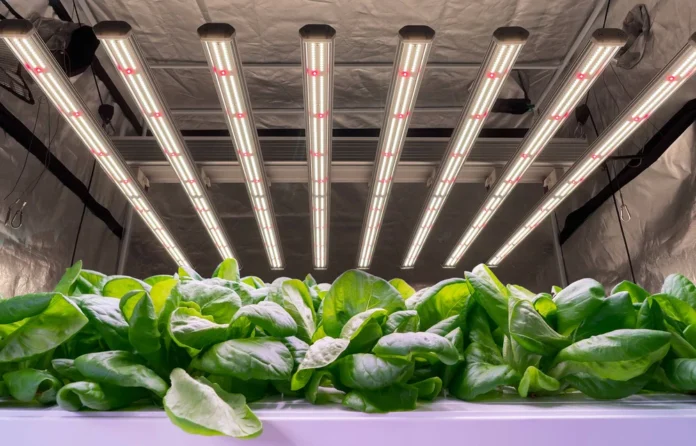
Indoor growing becomes much easier when the lighting is chosen with care. A strong lighting setup can support leafy greens, herbs, seedlings, and fruiting crops by giving them steady light in a controlled space. In hydroponics, that matters even more because the plant depends on the grower to supply water, nutrients, air, and light in the right balance. Hydroponics is a soil-free growing method that uses water-based nutrient solutions, and it is commonly used for home systems, greenhouse setups, and controlled indoor production.
That is where Hydroponic grow light full spectrum led fixtures come into the picture. They are designed to support plant growth indoors by providing a broad range of wavelengths, while also offering the practical benefits many growers want: good energy efficiency, long life, and less heat than older lighting styles. Extension sources note that LEDs are efficient, long-lasting, and available in a wide spectrum, while indoor hydroponic guides also emphasize that supplemental lighting can help when sunlight is limited.
The goal is not to buy the brightest lamp and hope for the best. The goal is to match the light to the crop, the system, and the growth stage. When that happens, a hydroponic garden can become far more stable, productive, and rewarding to manage.
What Makes This Lighting So Valuable
A Hydroponic grow light full spectrum led unit is useful because it gives the grower more control. Natural sunlight is excellent, but many indoor spaces do not receive enough of it, and many hydroponic systems are set up in places where daylight is inconsistent. A grow light fills that gap. Grow lights are electric lights used to aid plant growth, and they are commonly used for indoor gardening, plant propagation, and hydroponic food production.
A full-spectrum LED fixture is especially attractive because it is designed to cover a broad band of light rather than a narrow band alone. In practice, that usually means the plants receive a more balanced output that can be used across multiple growth stages. Some university guidance also notes that for many indoor plant situations, a “full-spectrum” or white light approach is often preferred over a narrow colored light setup.
For hydroponic growers, the real advantage is consistency. A lighting system that stays predictable day after day makes it easier to manage growth, spacing, feeding, and harvest timing. That consistency matters whether the goal is a few pots of basil or a larger tray of lettuce.
Why Hydroponic Systems Depend So Much on Light
In soil gardening, the ground buffers many mistakes. In hydroponics, the system is more direct. Plants are fed through water, and the root zone is controlled by the grower. Since the plant is already being asked to work in a managed environment, light must be handled with equal care. Hydroponic systems commonly use supplemental lighting indoors, and guides from extension services point out that lighting choice, energy use, and even light distribution at plant level are important parts of the setup.
Light is not only about “seeing” the plant. It drives photosynthesis and strongly influences how the plant grows, stretches, and flowers. When light is weak, plants may become stretched or underdeveloped. When light is too intense or too close, leaves can stress. When light is well matched, growth tends to be more even and dependable. University guidance also notes that plant growth is directly related to the amount of light energy received on leaf surfaces, and that supplemental lighting can reduce the risk that comes with low sunlight.
This is why Hydroponic grow light full spectrum led options are so popular for indoor growers. They combine controlled output with practical efficiency, helping keep the system manageable without sacrificing performance.
How Full-Spectrum LEDs Support Different Growth Stages
Plants do not need exactly the same light at every stage. Seedlings, leafy growth, and flowering all lean on light in slightly different ways. Research and extension material on indoor lighting note that red, far-red, and blue wavelengths are important for healthy plant development, while spectrum balance can influence flowering and plant shape.
Seedlings and Young Plants
Young plants usually benefit from gentle, steady light rather than a harsh blast. For seedlings, the most important things are even coverage, proper distance, and a schedule that keeps them from stretching too much. In many cases, the grower succeeds not because the lamp is exotic, but because the lamp is placed correctly and kept at the right intensity. One extension source notes that with indoor lighting, failures are often more about quantity and duration than spectrum alone.
A good Hydroponic grow light full spectrum led setup for seedlings should stay close enough to prevent stretching, but not so close that the leaves heat up or curl. A gentle start helps the plant build a strong stem and healthy leaf structure before it enters a faster growth phase.
Vegetative Growth
During the leafy stage, plants usually want strong but balanced light that encourages compact, vigorous growth. This is where a full-spectrum LED often shines. University extension guidance on LED grow lights points to their long lifespan, efficiency, and wide spectrum, while also noting their lower heat output compared with many alternatives.
For herbs like basil, parsley, and mint, or greens like lettuce and spinach, the vegetative stage is often the easiest place to see the effect of proper lighting. Leaves stay fuller, stems stay sturdier, and the plant is less likely to lean hard toward the light source. That creates a cleaner, healthier indoor garden.
Flowering and Fruiting
Flowering and fruiting crops are more demanding. They need not just enough light, but also the right rhythm and consistency. Spectrum can matter here because certain wavelengths influence plant development and flowering behavior. Research and extension resources note that light spectrum can help regulate flowering, and that red and blue wavelengths are especially important for plant development.
A Hydroponic grow light full spectrum led fixture is useful here because it keeps the plant under one dependable light source through the full cycle. That can help the grower avoid the confusion of swapping between different lamps for different stages. The right fixture can support a simpler routine and a cleaner result.
What to Look For Before Buying
Many grow lights look impressive in product photos. The smarter move is to examine the features that actually affect plant health and daily use.
Light Output and Coverage
Coverage matters more than style. A light that works beautifully over a small tray may perform poorly over a wide bed if the corners are left in shadow. Look for even distribution across the growing area so every plant receives a similar amount of energy. Indoor hydroponic guidance emphasizes the importance of uniform light distribution at plant level.
Spectrum Balance
“Full spectrum” is a useful phrase, but it should still be understood carefully. Many growers prefer a broad white output that feels natural to the eye and supports growth across multiple stages. Extension guidance says that for healthy plants under artificial light, supplying red, far-red, and blue wavelengths is important, and that full-spectrum or white light is often the best all-around approach.
Heat Control
Lower heat is one of the reasons LEDs are so attractive. Less heat near the canopy means a smaller chance of leaf stress and a more comfortable growing space. Extension material on LEDs notes that they are energy efficient, long-lasting, and do not produce too much heat.
Adjustability
A grower benefits from fixtures that can be raised, lowered, dimmed, or adjusted as the crop changes. Seedlings need a different setup than mature plants. If the fixture is flexible, the grower can adapt without buying a second lamp.
Energy Use
Hydroponics often runs for many hours each day, so efficiency matters. LEDs are a strong choice because they can provide broad light while using less power than many older options. That makes them practical for home growers who want a stable system without high running costs.
How to Set Up the Light Correctly
A good fixture can still perform poorly if the setup is careless. The placement, schedule, and surrounding environment all influence results.
Distance From the Canopy
The ideal distance depends on the fixture strength, the crop, and the growth stage. The lamp should be close enough to support strong growth, but far enough to avoid stress. A simple rule is to watch the leaves: if they curl upward, bleach, or look too warm, the light may be too intense or too close. If stems stretch hard in search of the lamp, the light may be too far away.
Daily Schedule
Plants need a steady rhythm. Many growers use a consistent daily photoperiod, especially for leafy greens and herbs. The schedule should be chosen according to the crop, not copied blindly from another setup. Consistency matters because plants respond to routine.
Reflective Surfaces
A bright wall, reflective panel, or clean grow area can help more light reach the plant. The goal is to use the lamp efficiently so the light is directed toward the canopy rather than wasted around the room. Grow light guidance has long emphasized efficient use of light and reducing wasted output.
Airflow and Temperature
Even with low-heat LEDs, airflow still matters. Moving air helps control humidity, keeps leaves dry, and makes the whole system feel more stable. Good airflow also helps prevent the grow space from becoming stagnant.
Best Crops for This Kind of Setup
Not every crop behaves the same indoors, but many popular hydroponic plants do very well under LED lighting.
Leafy greens are an excellent fit because they respond well to steady light and do not usually require extreme intensity. Herbs also work well because they are compact, fast-growing, and easy to manage under a small or medium fixture. The same is true for many starter plants and transplants. Indoor hydroponics is commonly used for lettuces, peppers, cucumbers, strawberries, and tomatoes, among others.
A Hydroponic grow light full spectrum led system is especially useful for lettuce, basil, mint, coriander, spinach, and similar crops because these plants reward consistency. When the light is balanced and the schedule is steady, the garden tends to look cleaner and grow more predictably.
Why Many Growers Prefer Full-Spectrum White Light
There is a reason many indoor growers move toward white, full-spectrum LEDs instead of purely purple lighting. White light is easier on the eyes, easier to inspect, and often more practical for a home environment. It also makes it easier to spot nutrient issues, leaf color changes, and pest problems early. Extension guidance notes that white or full-spectrum light is commonly favored for healthy plant growth under artificial light.
Another benefit is daily usability. A light that feels pleasant to work under is more likely to be maintained correctly. That matters because a growing system is only as good as the care it receives. If the light is unattractive, too harsh, or awkward to use, the whole setup can become inconvenient.
Common Mistakes Growers Should Avoid
A lot of indoor growing trouble comes from simple mistakes, not from bad plants.
One common mistake is using a light that is too weak for the space. Another is hanging the lamp too far from the crop. Some growers also keep the same setting for every stage, even though seedlings and mature plants do not need the exact same conditions. A third mistake is assuming that the newest-looking fixture will automatically be the best one.
Another mistake is ignoring the plant itself. Leaves often tell the story early. Stretching, discoloration, and curling are signals worth paying attention to. A good grower learns to read those signs and adjust quickly.
A final mistake is overcomplicating the setup. The best hydroponic system is not the most complicated one; it is the one that is stable, clean, and repeatable. That is why a Hydroponic grow light full spectrum led setup should be chosen with simplicity in mind.
Maintenance That Keeps the System Healthy
LED fixtures do not demand much maintenance, but they still deserve basic care. Dust can reduce performance, so the surface should be kept clean. Cords should be checked regularly. Hanging hardware should be secure. If the light is dimmable or adjustable, settings should be recorded so the grower can remember what worked well.
The wider hydroponic system matters too. Reservoirs should stay clean, nutrient levels should be monitored, and the roots should not be left in a harmful condition. Hydroponic production depends on balancing light, water, nutrients, air, heat, and space.
When the light and the hydroponic system work together, the garden becomes much more reliable. That is the real strength of a well-built indoor setup.
Budget-Friendly Ways to Improve Results
A strong result does not always require a large budget. Sometimes a better hanging position, a cleaner grow space, or a more reflective wall can improve output without replacing the fixture. A small system can also be organized more efficiently by keeping crops at similar heights and grouping plants with similar needs together.
Home hydroponics is often attractive because it can be tailored to the owner’s space and effort level. Extension guidance notes that home hydroponics can provide year-round produce and can use significantly less water than conventional growing.
That means the real goal is not to buy more equipment than necessary. The goal is to make every part of the system work better. A carefully chosen Hydroponic grow light full spectrum led fixture supports that goal by giving the grower a dependable base to build on.
For more ideas on building a plant-friendly indoor environment, these Business To Mark articles connect well with hydroponic growing and lighting design: Contemporary Bathroom Design Trends for Modern Homes explores living walls and natural light; Modern Garden Rooms: A Blend of Nature and Comfort discusses spaces that bring nature closer to the home; and 25 Simple DIY Home Decor Ideas to Make Your Living Room Look Expensive includes lighting and biophilic touches that pair nicely with indoor greenery.
For a general reference on the science behind artificial plant lighting, see Grow light. It gives a simple overview of what grow lights do and how they are used in indoor cultivation.
Practical Buying Mindset
The smartest buyer thinks in terms of the crop, not the catalog. A lettuce tray does not need the same treatment as a flowering fruit crop. A small shelf garden does not need the same fixture as a larger hydroponic bench. The best light is the one that matches the plant’s real needs.
When comparing options, keep asking a few simple questions: Does the light cover the full canopy? Does it stay cool enough for indoor use? Does it offer a balanced spectrum? Is it easy to adjust as the plants grow? If the answer is yes, the fixture is moving in the right direction.
A Hydroponic grow light full spectrum led system works best when it is treated as part of a complete growing environment. Light, water, nutrients, spacing, and airflow should all support one another. That is how a home hydroponic garden becomes more than a hobby and starts becoming a dependable source of fresh produce.
Final Thoughts
Indoor growing rewards patience and consistency. A strong light does not replace good care, but it makes good care far more effective. In a hydroponic garden, the right fixture can guide seedlings gently, support leafy growth cleanly, and help mature plants stay productive through the full cycle. Extension sources repeatedly show that LED grow lights are efficient, long-lasting, and useful in indoor production, while hydroponic systems benefit from thoughtful supplemental lighting and balanced environmental control.
That is why Hydroponic grow light full spectrum led has become such a practical choice for home growers and indoor gardeners. It brings together broad-spectrum support, everyday efficiency, and the flexibility needed for a controlled growing space. With the right setup, the result is a cleaner garden, healthier plants, and a more satisfying harvest.