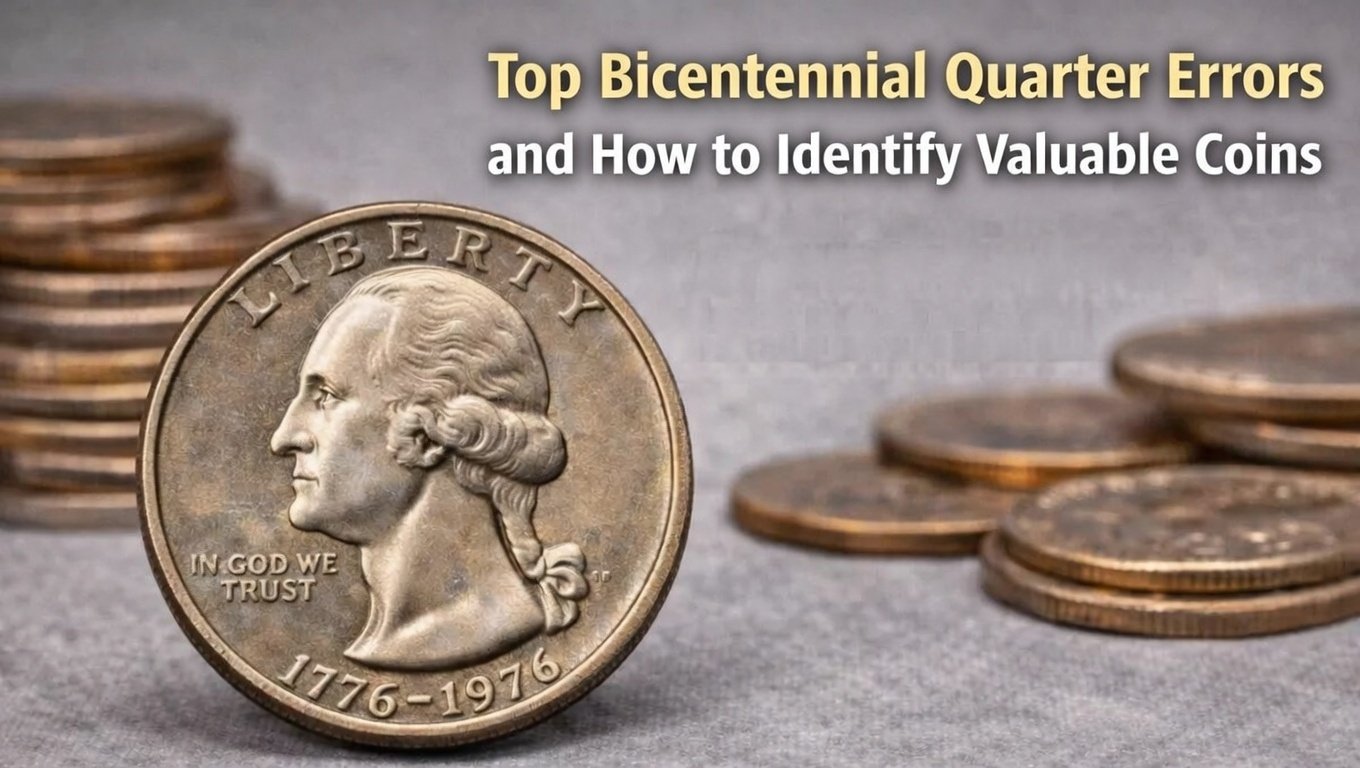
The 1776-1976 Bicentennial Quarter is one of the most iconic coins in American history. Featuring a unique reverse design of a colonial drummer boy, it was minted to celebrate the 200th anniversary of the United States. While you might have a handful of these quarters in your pocket change, specific errors and varieties could make you the owner of a small fortune. Some rare examples have been valued at thousands—and in extreme cases, even millions—of dollars.
In this guide, we will walk you through the Top Bicentennial Quarter Errors and How to Identify Valuable Coins. Whether you are a seasoned numismatist or just curious about the loose change in your drawer, understanding these key details can help you spot a hidden gem.
A Quick History of the Bicentennial Quarter
Before diving into errors, it helps to understand the coin itself. The U.S. Mint produced the Bicentennial quarter in 1975 and 1976, bearing the dual date 1776-1976. Designed by Jack L. Ahr, the reverse depicts a colonial drummer boy and a victory torch encircled by thirteen stars.
These coins were minted in massive quantities across three facilities:
-
Philadelphia: No mint mark (over 800 million struck).
-
Denver: “D” mint mark (over 860 million struck).
-
San Francisco: “S” mint mark. These are the key to finding silver, as San Francisco produced both 40% silver uncirculated and proof versions .
Why Are Some Bicentennial Quarters Worth Millions?
While most of these quarters are only worth their face value of 25 cents, specific factors skyrocket their worth. The primary drivers of value are rarity, condition, and errors. For example, a standard 1976-D quarter in perfect condition (MS68) sold for nearly $6,500 at auction, while rare error coins have been rumored to approach values of $5 million in unique circumstances .
The key is identifying which errors are genuine and how to spot them. This is where our focus on the Top Bicentennial Quarter Errors and How to Identify Valuable Coins becomes essential. Just like understanding the fine print in legal documents, such as an errors and omissions insurance attorney would review, spotting minute details in coinage requires a trained eye.
Top Bicentennial Quarter Errors to Look For
Errors occur during the minting process. These anomalies make a coin unique and highly collectible. Here are the most valuable errors to watch for:
1. Doubled Die Obverse (DDO) and Reverse (DDR)
This is one of the most popular errors. It happens when the die strikes the coin multiple times at slightly different angles, creating a “ghost” or doubling effect.
-
How to Identify: Look closely at the lettering. On the obverse (front), check “LIBERTY” and “IN GOD WE TRUST.” On the reverse, look at the drummer boy’s details or “UNITED STATES OF AMERICA.” If the letters look fuzzy or have a doubled outline, you may have a valuable coin .
-
Value: Depending on the severity and grade, these can range from $50 to over $2,000.
2. Off-Center Strikes
Sometimes, the blank coin (planchet) is not positioned correctly when struck, causing the design to be misaligned.
-
How to Identify: Part of the design will be missing or pushed to the edge of the coin. The more dramatic the off-center strike (20% to 50% off), the more valuable it is—provided the date is still visible .
-
Value: Generally ranges from $100 to $1,500+.
3. Missing Clad Layer / Wrong Planchet Errors
Regular Bicentennial quarters are made of copper-nickel clad (a copper core sandwiched between nickel layers). Sometimes, the outer layer is missing, or the coin was accidentally struck on a planchet intended for another denomination (like a dime) .
-
How to Identify: If the coin looks unusually thin or has a different color (like a solid copper hue), it might be a missing clad error. If it feels too light or too heavy, it could be a wrong planchet.
-
Value: These are exceptionally rare. A Bicentennial quarter struck on a dime planchet has sold for over $9,000 .
4. Double Strikes
This occurs when a coin is struck more than once and stays in the collar (the machine that holds it). The design will appear overlapping or heavily distorted.
-
How to Identify: Look for clear overlapping images. A famous example is a Proof Bicentennial Quarter double struck on a Roosevelt Dime, which is a unique and incredibly valuable piece .
-
Value: Can range from $10,000 to $25,000+ depending on clarity and condition.
5. The “Filled D” Error
This is a subtle but collectible error specific to Denver mint coins.
-
How to Identify: The “D” mint mark looks filled in or solid due to grease or debris in the die.
-
Value: While common, well-preserved examples can bring a small premium over face value .
How to Identify Valuable Coins: A Step-by-Step Guide
Now that you know what errors look like, here is a practical guide to identifying valuable specimens. Just as following a process helps troubleshoot a robotic error message NYT style tech issue, following these steps ensures you don’t miss a valuable detail.
-
Grab a Magnifying Glass: You cannot spot doubling or small mint mark anomalies with the naked eye. A 5x to 10x loupe is essential.
-
Check the Mint Mark: Look for the “S” mint mark. This is your first indicator of a possible silver composition. Silver coins weigh slightly more (5.75g) than clad coins (5.67g) and have a solid silver edge rather than a copper stripe .
-
Inspect the Edge: Look at the rim of the coin. Clad coins will have a visible brown stripe (the copper core). Silver coins will be solid gray.
-
Look for Doubling: Scrutinize the letters “LIBERTY” and the date “1776-1976.” If the letters look like they have shadows, you may have a doubled die.
-
Examine the Design Completeness: Is the drummer boy fully visible? If part of the design is cut off, it could be an off-center error.
-
Don’t Clean the Coin: This is the golden rule. If you find a potential treasure, do not clean it. Cleaning scratches the surface and destroys the natural “luster,” drastically reducing the value .
The Importance of Professional Grading
Once you think you have found a rare coin, you need to authenticate it. Just as you would read a detailed breakdown of Bicentennial Quarter Errors and Varieties before buying, you should have your coin reviewed by a professional.
Services like PCGS (Professional Coin Grading Service) or NGC (Numismatic Guaranty Corporation) will authenticate the coin, grade its condition on a scale of 1 to 70, and encapsulate it in a protective holder. A coin graded MS67 or higher can be worth exponentially more than an ungraded “raw” coin . In fact, PCGS graded 28 of the top 30 most valuable coins sold in 2025, underscoring the trust in professional certification .
Conclusion
The hunt for rare coins is an exciting blend of history and treasure hunting. While the chances of finding a $5 million coin are slim, discovering a high-grade silver proof or a significant doubled die error is entirely possible. Remember to check your pocket change, look for the “S” mint mark, and always inspect for doubling or missing details.
Now that you know the Top Bicentennial Quarter Errors and How to Identify Valuable Coins, it’s time to check your collection. Have you ever found a coin that looked a little “off”? Share your discovery in the comments below—you might just have a hidden fortune in your hands!
References
-
Mint Error News: Proof Bicentennial Quarter Double Struck on Dime
-
PCGS: Top 30 Most Valuable Coins Sold in 2025
-
Accounting Insights: Bicentennial Quarters Worth Money
-
FindBullionPrices: Bicentennial Quarter Values & Auction Records
-
KMC News: The $5 Million Bicentennial Coins